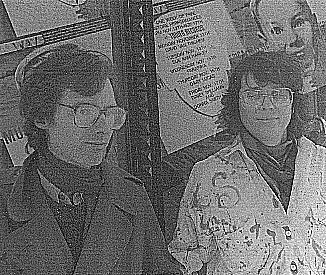
Trans Duo: LaDonna Smith and Davey Williams (reflection in storefront)
New Music America, NYC
(photo by Alice Faye Love)
TransMuseq History
Davey and LaDonna met in 1973. Introduced by Anne LeBaron, they piled into her beat up gold Cutlas station wagon, and off they went to a local County Fair. (How Surreal is that?) Before the evening was over, they found themselves revolving high over the countryside on the top of a Farris wheel, a sure auspicious sign that something unusual was up. Intuitively, they could see it, feel it, the beginning of something significant. LaDonna was involved in experimental music, electronics and composition, while Davey had been investigating free playing, having newly discovered the European improvisation movement through Incus and FMP recordings found at the local head shop. In a followup meeting to 'improvise' together, their long-term relationship was born. Improvisation sessions developed into an innate and mutual psychology of playing music, utilizing stream of consciousness and automatism. Their aim was to create music in which the performer and composer were one, producing a music inspired the the moment as an act of composing and expressing at once. Their music differentiated itself from the then common jazz-influenced jamming, evolving from an eclectic palette, a classical as well as blues & soul background, from influences like Pierre Henry, Stockhousen and Derek Bailey to phenomena like train engines, found sound, howling wolves and noise.
In 1974 they dove into an avid exploration of art of free-improvisation with an emphasis on music that was as shaped and crafted as composed music. Digging for a near-psychic method of spontaneous composition, their first concert was held at the Ferguson Center on the University of Alabama campus on April 7, 1974. LaDonna on piano, her then primary instrument, experimenting on the viola, the instrument which would develop into her forte; while Davey played both the Gibson Les Paul guitar and bass clarinet. This was clearly the beginning for the developmental period, and carreer which was to follow.
In 1976, they released their first L.P., a collective of five musicans, who were improvising regularly, who called themselves "Transcendprovisation". They were Adrian Dye, an organist; Theodore Bowen, bassist, and Timothy Reed (alias. Fred Lane) who performed on woodwinds and brass, but at the time favored heavily the alto flute. "Transcendprovisation" later expanded personel to include James Hearon on violin & electronics, as well as Anne LeBaron on harp. Both have gone on to make names for themselves in the academic & composition worlds. Adrian Dye now lives in Thailand, the "Land of Smiles."
The TRANS DUO moved to Birmingham in 1978, and developed long term collaborations with cellist,
Doug Carroll (now in San Francisco) and saxophonist, Wally Shoup (now in Seattle). With collaborators, they went on to develop the art of improvisation in collaboration with dancers, Mary Horn, Sycamore, Susan Hefner, and Juanita Suarez among others who have been part of the long improvisational dance history in Birmingham. More LP releases followed through their own recording company, TransMuseq.
They promoted the art of free improvisation in Alabama, bringing the world's renowned improvisers to the state of Alabama. Some of the earliest Concerts featured: Derek Bailey, Evan Parker, Andrea Centazzo, Eugene Chadborne and John Zorn, Tristan Honsinger, Paul Lovens & Barry Guy, Maarten Altena, Peter Cusack, Steve Beresford, Gunter Christmann and Torsten Muller, Toshinori Kondo, Alexander von Schlippenback, Phil Minton, Joe McPhee, Oliver Lake, Borbotemagus, Jack Wright, John Oswald, Tom Guralnick, Raymond Boni, Tony Wren & Marge McDaid, Phil Minton & Roger Turner, Tim Hodgekinson, Paul Lytton and many, many others. Through the Improvisation Series at BCDC in the 1980's, there was a consistent stream, educating the local Alabama culture in small, but potent Concerts of the greatest improvisers of the time.TRANS DUO began to get invitations to tour, in North America and abroad. First to San Francisco and New York, then to England and Italy. Then to Belgium, Germany, Switzerland, Jugoslavia, France and Canada. The list goes on…Providence, Philadelphia, Milwaukee, Grand Rapids, etc. It seemed that many curious organizers were interested in booking this "novelty act" from L A (Lower Alabama). They were
invited to New Music America in 1981, to the Canadian "Ear It Live Festival," to tour Europe, and played the prestigious Moers Festival in 1980, Berlin's UND, and traveled across Europe, the USA and Canada.In 1980, they were founders in organizing the Improvisors Network (IN) based in New York City for the purpose of "networking musicians with other musicians to fascilitate a network of improv gigs produced around the country. Organizers on the IN Board included: Leslie Dalaba (Pres), Chris Cochran, Cinnie Cole, Davey Williams, LaDonna Smith, and Jack Wright. Davey Williams became the founding editor of the IN newsletter which appeared in Autumn of 1980. From this 4 panel newsletter of the Improvisor's Network, the improvisor, the international journal of free improvisation was born. From a 4 page newsletter, it expanding through stages of magazine, journal, to an internet presencel in the 1990's. The 30 year anniversary of the improvisor was celebrated in 2010 with a month long festival hosted in five American cities: Birmingham, Chattanooga, New York, Seattle, and Athens, Ga .
the improvisor has provided a forum for philosophy, theory, and information exchange for 35 years.
TRANS Davey Williams and LaDonna Smith
(photo by Alice Faye Love)As free improvisation has direct commonalities with the practices of "automatism" in Surrealism, Davey Williams and LaDonna Smith were involved in artistic practices and methods espoused by the international surrealist community in the 1980's. An offshoot of the larger Raudelunas Pataphysical Revue, the Glass Veal Group, became a concentrated surrealist entity in Birmingham, (Iron Tortoise) Alabama. They met daily/weekly to practice automatic writing, painting, and drawing. They performed Surrealist poetry readings, and performed Surrealist theater events. In their travels, they would seek to find and meet many of the original and currently active Surrealists. Some of the painters and writers they met in Europe were Jose Pierre, Eduard Jaguer, A.K. El Janaby, and E.F. Grannell. They also sought out meetings with the Chicago surrealists Franklin and Penelope Rosemont, Hal Rammel, Joel Williams, J. Karl Bogartte, Robert Green & Debra Taub, among others. Correspondence with many others and over time, some Surrealists practitioners visited Alabama, including Swedish Johannes Bergmark, Australia's Tim White and Wisconsin's Hal Rammel and Gina Litherland. Through these alliances, a number of poetic and theoretical publications came to be. Their imagery, poetry and articles appear in surrealist literary publications such as Glass Veal I and II, Beef Sphinx, The Divining Tongue, the "Radio Plays", The Hourglass, The Dirt Furnace, Free Spirits,
Exposcao Internacional Surrealismo & Pintura Fantastica, Dungannon, and Arsenal.See TransMuseq Discography.